
Last Updated: September 28, 2026
Why 10-Minute Habits Stick - and How Crochet Became Mine
Build a 10-minute crochet habit that actually sticks — even with kids, chaos, and zero spare time. Science-backed micro-habit strategies for busy moms.
You finally sat down.
The kids are (sort of) settled. The dishes are in a pile you’ve agreed to pretend isn’t there. You have exactly twelve minutes before someone needs something — so you pick up your phone.
Forty-seven unread tabs. A group chat you forgot to respond to (a week ago). An Instagram reel about a woman who apparently meal-preps, works out at 5 am, and has a hobby turned side-hustle.
Good for her, you think. Must be nice.
A 10-minute crochet habit for busy moms isn’t a lifestyle overhaul — it’s a tiny, proven way to come back to yourself. Behavioral scientist BJ Fogg has found that small, repeated habits build stronger neural pathways than occasional long sessions. Ten minutes a day is enough.
This post covers why moms lose their hobbies (it’s not laziness), what crochet actually does to your nervous system, and how to build a micro-habit that holds on your worst Tuesday.
Why Busy Moms Lose Their Hobbies — And Why It’s Not About Time
The real reason moms stop doing things they love isn’t a lack of time — it’s guilt. Not the loud, obvious kind. The quiet kind that makes you put down the yarn because you could be doing something “useful.” The kind that makes scrolling feel more acceptable than crocheting, because at least scrolling feels passive.
That’s cultural conditioning, but it is not truth. It is, unfortunately, deeply internalized, and it runs the show for a lot of moms.
When an activity gets framed as a luxury, it must be earned. So a simple, restorative creative outlet gets deprioritized — until it disappears altogether. The fix isn’t better time management. It’s reframing rest and creativity as necessary, not indulgent.
For more information on the benefits of crochet, please read: The Case For Crochet: What Research Says About Creativity and Mental Health.
When Did “What Do You Do for Fun?” Become a Hard Question?
Most moms can’t answer “what do you enjoy right now?” immediately — and that pause is worth paying attention to. It’s not that they’ve forgotten how to enjoy things. It’s that the mental load of motherhood is so constant that even leisure time gets task-ified.
You’re making grocery lists while you watch TV. Planning tomorrow’s lunches while you vacuum. Mentally tracking twelve things that need to happen by Friday while you are technically “relaxing.”
That kind of cognitive noise — what researchers call cognitive load, the total mental demand placed on working memory at any one time — doesn’t leave much room for creativity. A crochet habit works precisely because it gives that part of your brain somewhere specific to go.
What Crochet Does to Your Nervous System (The Science Is Surprisingly Good)
Crochet’s repetitive, rhythmic motion has a measurable calming effect on the nervous system — comparable in some studies to meditation. Research published in the British Journal of Occupational Therapy (2013) found that 81.5% of respondents who knitted regularly reported feeling calm and happy after their sessions, with significant correlations to reduced depression and anxiety.
Here’s what’s happening physiologically:
- Heart rate and cortisol drop. The predictable, repetitive sequence of stitches activates the parasympathetic nervous system — the body’s “rest and digest” response.
- Flow state activates. Crochet produces what psychologist Mihaly Csikszentmihalyi — who first defined flow as a state of complete absorption in an intrinsically rewarding activity — described as effortless focus.
- “Soft fascination” kicks in. This term, used in attention restoration theory developed by Rachel and Stephen Kaplan at the University of Michigan, describes how mildly engaging, non-demanding tasks replenish directed attention. Crochet is the textbook example: simple enough to soothe, engaging enough to quiet the noise.
For moms who’ve tried meditation and found it impossible to sit still with their thoughts, crochet offers something different — active focus that doesn’t require you to empty your mind.
[“British Journal of Occupational Therapy knitting study”]
The “I Made Something” Effect — Why Visible Progress Matters for Moms
Crochet gives you physical proof of your effort — and for moms, that’s rarer and more restorative than it sounds. So much of what mothers do is invisible: the emotional labor, the logistics, the anticipating and smoothing over. None of it leaves immediate evidence. You do it, and then you do it again tomorrow.
That invisibility accumulates. Over time, it can create the feeling that you’re not building anything at all — even when you’re holding everything together (you are super-woman – seriously).
This is where a row of stitches at the end of ten minutes that wasn’t there before is real. A dishcloth, a granny square, a little something that exists because you made it and now the proof is in your hands. Even if isn’t perfect and the stitches are messy, there is no denying the effort you put in produced something tangible. Research on self-efficacy — the belief in your ability to accomplish tasks, as defined by psychologist Albert Bandura — shows that small, visible wins compound into stronger confidence over time.
This is why beginner crochet projects matter strategically, not just practically.
This is also a great time to remind you that Instagram is a highlight reel. It is easy to see creators making beautiful blankets, sweaters or even stunning beaded jewelry and become overwhelmed.
But you don’t know their story. They may have 5 hours a day to crochet. Don’t worry about focussing on beginner patterns right now. The wardrobe of handcrafted clothes isn’t the goal – creating a habit and proof of your effort is.
There is a plethora of beginner patterns available online. Here is a link to one of my favorites: Easy Crochet. They have their patterns categorized so well – worth checking out for inspiration!
Why a 10-Minute Crochet Habit Works Better Than a 2-Hour One
Doing something for ten minutes every day builds a stronger habit than doing it for two hours once a week — and the behavioral science backs this up clearly. BJ Fogg, behavioral scientist at Stanford University and author of Tiny Habits (Houghton Mifflin Harcourt, 2019), found that smaller habits are more durable because the brain builds identity through repetition, not intensity.
James Clear, author of Atomic Habits (Avery, 2018), frames it differently: you don’t rise to the level of your goals, you fall to the level of your systems. A 10-minute habit is a system that works on your worst day.
This is what makes micro-habits — small, consistent behaviors attached to existing routines — different from the “wake up an hour earlier” advice that doesn’t account for the night your baby woke up four times.
Micro-habits for moms work because they’re achievable on your most exhausted, most chaotic Tuesday. That’s not settling. That’s smart design.
Here are the links to BJ Fogg’s Tiny Habits framework & James Clear’s Atomic Habits.
How to Build Your 10-Minute Crochet Habit (Without Burning Out)
The most effective crochet habit routine for busy moms uses one strategy: attach the new habit to something you already do every day. BJ Fogg calls this a “habit anchor” — an existing behavior that reliably cues the new one.
A few real examples:
- After I pour my morning coffee, I crochet for 10 minutes before I look at my phone.
- During my kids’ 20 minutes of screen time, I crochet instead of doing chores.
- After the bedtime tuck-in, I pick up my crochet before I turn on the TV.
Pick the realistic time, not the aspirational one. If you fantasize about peaceful morning sessions but sleep to the last possible minute, evenings are your anchor — and that’s a feature, not a failure.
What You Actually Need to Get Started (It’s Less Than You Think)
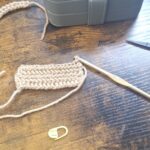
The barrier to entry for crochet is intentionally low:
- A crochet hook: $3–$8 at any craft store. Size 5mm (H/8) is the standard beginner recommendation.
- One skein of medium weight (Category 4) yarn: $5–$10. Lion Brand Pound of Love or Red Heart Super Saver are beginner-friendly and widely available.
- 20 minutes of YouTube: Channels like Bella Coco Crochet or Crafting with Ellen are designed for absolute beginners.
That’s it. No studio. No starter kit. No dedicated craft room. A hook, some yarn, and that tote bag from Trader Joe’s you never remember at the grocery store.
What to Do When You Miss a Day (Because You Will)
Missing one day of a habit does not break the habit — research consistently shows that a single lapse has no meaningful impact on long-term success. Phillippa Lally, a health psychology researcher at University College London, found in a 2010 study published in the European Journal of Social Psychology that missing one day had no detectable effect on habit formation outcomes.
The risk isn’t the missed day. It’s the story you tell yourself about it.
The rule: never miss twice. One day off is rest. Two days off is the start of stopping. When life happens — stomach bugs, sleepless nights, just not feeling it — acknowledge it, put down zero guilt, and pick the hook back up tomorrow.
[Cataloguing Joy walks you through how tracking your habit improves more than you think.]
What Mom Guilt Says — And What to Say Back
Choosing to crochet while the kids are awake is not selfish — it’s modeling. And what your kids are actually learning when they watch you put down your phone and pick up something creative is worth more than any productivity lecture you’ll ever give them.
When they see you spend ten quiet minutes doing something just because you enjoy it, they absorb:
- Adults have inner lives and interests
- How to sit with focus and do one thing at a time
- That rest and creativity are legitimate — not things to be earned
- How to build and sustain a habit through consistency, not perfection
Rest, creativity, and play are not the opposites of productivity. They’re the foundation from which a sustainable, non-exhausted life gets built — and that’s the lesson worth modeling.
To understand how modeling impacts your kids – and why it is so important to model creativity, read Monkey See, Monkey Do. It will tell mom guilt over taking time for your crochet or any other creative practice to take a hike.
FAQs: Building a Crochet Habit as a Busy Mom
Q: How do I start crocheting with no experience and very little time?
A: Start with a size 5mm (H/8) hook and one skein of medium weight yarn — both available at most craft stores for under $15 combined. Watch a 20-minute beginner tutorial on YouTube (Bella Coco Crochet is a popular starting point) and practice the chain stitch and single crochet before trying a project.
Q: Is 10 minutes of crochet actually enough to make a difference?
A: Yes — for both habit formation and stress relief. BJ Fogg’s research at Stanford confirms that consistent short sessions build stronger neural pathways than infrequent long ones. And the parasympathetic nervous system activation that makes crochet calming begins within minutes of starting repetitive motion.
Q: What if I keep forgetting to crochet or losing momentum?
A: Attach your crochet habit to an existing daily anchor — morning coffee, kids’ screen time, or post-bedtime wind-down. Habit trackers also help: visual streaks activate the “don’t break the chain” motivation effect identified in behavioral psychology research.
Also, tell your kids what you are doing!
This one sounds strange, but kids LOVE routine – they thrive on it. If you want an automatic reminder, then talk to them about your new habit and about the routine you are trying to establish. I can almost guarantee they will ask after it in the sweetest, most excited way.
Take it one step further and have them color in each day of your 10-Week Habit Tracker (grab it for free). Those adorable little maniacs will LOVE to help in this way – and it provides a nice dose of accountability for you…
Q: Can I really do this with small children around?
A: Most beginner crochet projects require enough focus to be engaging but not so much that interruptions are catastrophic. Many moms find it works well during parallel play, screen time, or any predictable daily pause. The hook and yarn pack into a small bag easily — it’s one of the most portable creative hobbies available.
Q: What’s the easiest beginner crochet project for a busy mom?
A: A simple dishcloth or granny square — both use only the chain stitch and single crochet, take 1–3 sessions to finish, and give you a visible, usable finished product fast. Visible wins early in a new habit significantly increase the likelihood you’ll continue.
Start With Ten Minutes — That’s All This Requires
A 10-minute crochet habit for busy moms works because it’s built for real life, not an idealized version of it. Small and consistent beats big and occasional — every time, for every person, at every stage of motherhood.
You don’t need more time. You need a system that works on your worst day.
Take the quiz to find out how 10 minutes fits best in your life.
Did this resonate? Save it for a mom who needs to hear it — or drop a comment below and tell us what brought you here.
Pingback: The Case for Crochet: What the Research Says About Creativity and Mental Health - My Daily Stitch
Pingback: Elementor #1753 - My Daily Stitch
Pingback: Monkey See, Monkey Do: How Your Habit Teaches Your Kids - My Daily Stitch