
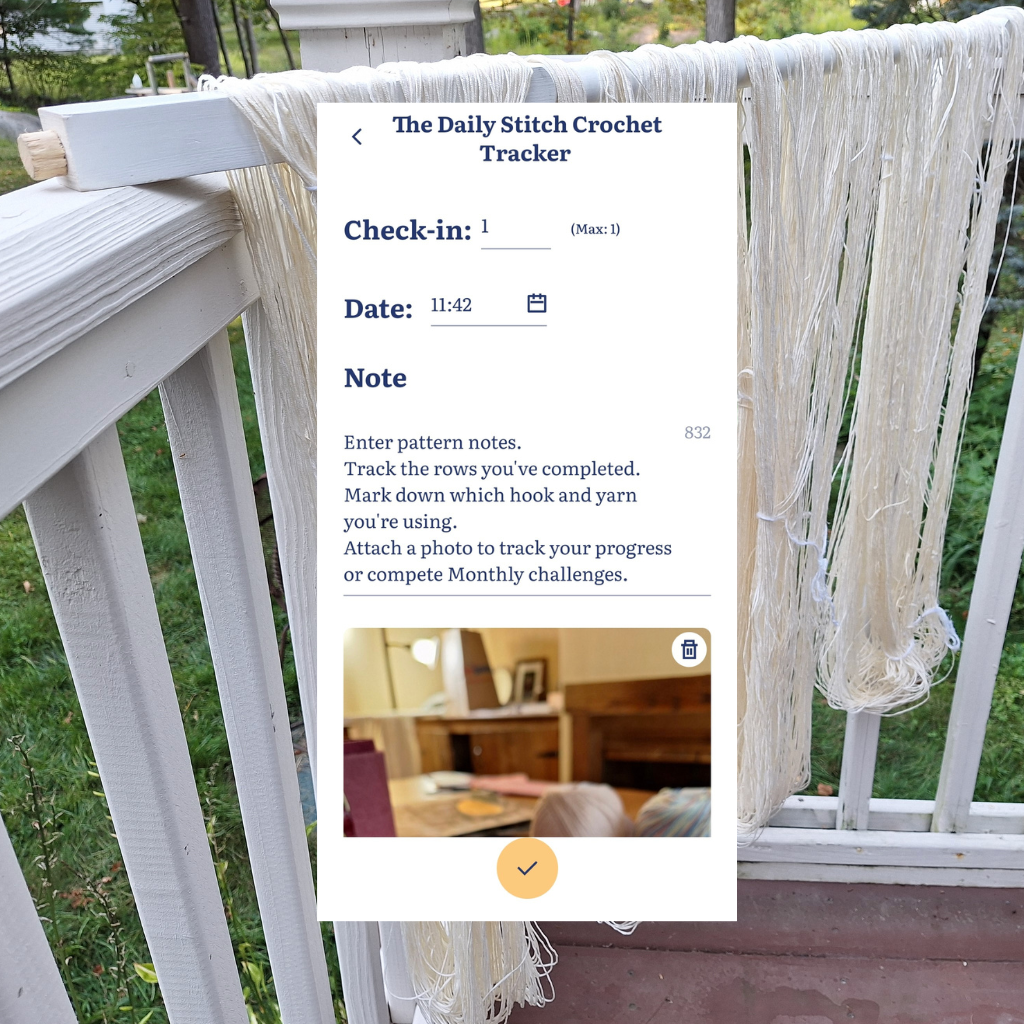
Cataloguing Joy: Why Tracking Your Crochet Habit Changes More Than Your Streak
Your crochet habit tracker isn’t a productivity tool — it’s backed by savoring research, gratitude science, and the psychology of joy. Here’s why it works.
Tracking your crochet habit does more than log your sessions — it builds emotional resilience, trains your brain to notice positive experiences, and creates a returnable record of who you’re becoming.
Most habit trackers are sold as accountability tools. Check the box, maintain the streak, don’t break the chain. That framing puts the wrong thing at the center. It turns a creative practice into a performance review.
What your crochet habit tracker is actually doing — when it’s working right — is something the research on savoring, gratitude, and positive psychology has been describing for decades. It’s not counting your output. It’s cataloguing your joy.
Here’s what that means, and how focussing on the positive, wonderful moments of your life, has a lasting ripple effect that you might not expect.
Why a Crochet Habit Tracker Works Differently Than a Productivity App
A crochet habit tracker builds emotional resilience by creating a physical record of your positive creative experiences. When you need a reminder that the world can, in fact, be beautiful, you can return to — not just data about whether you completed a task, but evidence that happy, peaceful moments happened. This distinction matters because the psychological mechanism behind tracking isn’t accountability. It’s savoring.
Savoring — defined by psychologists Fred Bryant and Joseph Veroff as the intentional use of thoughts and actions to prolong, intensify, or generate positive emotions — is one of the most well-supported frameworks in positive psychology. [1]. Unlike passive enjoyment, savoring is active. You do it on purpose. And your habit tracker, it turns out, is one of the best savoring tools available.
Most productivity apps measure output. A crochet habit tracker, used intentionally, measures something closer to presence — the simple, but weighty fact that you showed up for yourself today.
What Is Savoring in Psychology, and Why Does It Apply to Crochet?

Savoring, in positive psychology, is the practice of deliberately noticing and extending positive emotions — before, during, and after an experience. Bryant and Veroff’s research identifies three distinct savoring dimensions: anticipating a future positive experience, being fully present during it, and reflecting back on it afterward. [1]
You already know what this feels like, even if you’ve never heard the term. It’s what happens when you get together with a close friend and you laugh over an old memory — suddenly you’re flooded with the positive emotions of the original event all over again. You are enjoying the current moment, laughing with your friend and you are planning the next time you get to experience this joy.
That’s savoring. It happens naturally with people we love.
How Your Habit Tracker Covers All Three Dimensions of Savoring
A well-designed crochet habit tracker engages all three dimensions automatically.
- When your tracker is filling in, you start to look forward to your sessions before they happen.
- The act of checking the box anchors you to the present-moment satisfaction of having shown up.
- And when you look back at weeks of marks, you’re actively reminiscing — re-accessing the emotional benefit of each session you’ve already had.
That’s not a streak. That’s a compounding record of your own wellbeing.
Let’s look at each dimension in greater detail.
Dimension 1: Reminiscing (The Past)
Reminiscing — reflecting on positive memories to re-experience their emotional benefits — is the first savoring dimension, and it’s where a completed tracker becomes genuinely powerful. When you look back at ten weeks of marks, you’re not just seeing data. You’re re-accessing the calm of that Tuesday morning session, the satisfaction of finishing your first project, the quiet pride of a week that survived a hard stretch.
Savoring research confirms that reflecting on positive experiences strengthens both memory and emotional resilience over time [1]. A completed tracker is a tool for reminiscing — and reminiscing is neurologically beneficial.
Research published in the Journal of Personality and Social Psychology found that participants who regularly recorded positive experiences reported greater optimism, improved mood, and higher life satisfaction — specifically because recording shifted their attention toward those experiences and made them easier to return to. [2]
Your crochet tracker functions as a gratitude journal for your creative practice.

Dimension 2: Mindful Immersion (The Present)
Present-moment savoring means deliberately anchoring yourself to the positive emotion of an experience while it’s happening — amplifying joy in real time rather than letting it pass unnoticed. This is exactly what the check-in step in your habit loop does.
When you finish your ten minutes and mark it down — when you pause to register “I did that” — you’re savoring in the present tense. Research on savoring interventions consistently shows that deliberately marking the completion of a positive experience amplifies its emotional impact [4].
The act of checking your tracker is not administrative. It is the reward. For moms whose effort is largely invisible, the act of witnessing your own small daily win carries outsized emotional weight.
Dimension 3: Anticipation (The Future)
Anticipatory savoring means looking forward to a positive experience in a way that generates positive emotion before the experience even begins. In the early stages of a new habit, you show up because you’ve committed. Over time, something shifts: you start to actually look forward to it.
That shift doesn’t happen by accident. It happens because your habit tracker makes the habit feel real. Seeing your own consistency reflected back — weeks of marks on a page — is part of what creates anticipation. It makes you feel real, as someone who has this practice.

Does Tracking Small Habits Actually Improve Your Mental Health?
Tracking small daily creative habits genuinely improves mental health — not because of the output produced, but because of the attention it trains. A 2018 study published in the Journal of Positive Psychology found that small daily creative actions — not finished projects or major achievements, but ordinary repeated positive experiences — predicted flourishing, positive affect, and engagement. [3]
The benefits accumulated through consistency and repetition, not productivity are what moved the needle. Which means five minutes counts. And half-finished row counts. Even just showing up on a hard day with your minimum viable habit counts — maybe most of all.
Research in Frontiers in Psychology reinforced this further: daily positive record-keeping — journaling, gratitude lists, habit logs — increased positive affect and life satisfaction while reducing depression symptoms. The mechanism was attention: repeatedly directing your focus toward positive experiences changes what your brain notices, and what your brain notices shapes how you feel. [5]
Your crochet tracker directs your attention toward the ten minutes that were yours. Toward the time you invested in creating something beautiful.
Why I Built the Tracker This Way
I want to be honest about something: when I first sat down to design the My Daily Stitch habit trackers, I had to resist the pull toward streaks and scores. They’re satisfying to design. They create urgency. And they work, for a while.
After all, it was my 300-day streak on Duolingo that kick-started all of this. I know that gamification works for me.
But I kept coming back to one grounding thought: even after 300 days of Duolingo, I didn’t feel at peace. Crochet has always given me that peace, and it’s the part I missed most. I imagine you feel the same about your craft.
Moms don’t need another measurement of how productive they’ve been. The last thing I wanted to create was another source of stress.
So I designed every tracker around one question: what would make someone want to come back and look at this? Not to check a score, but because looking at it reminds them of who they were, who they are, and who they can be.
It’s also why there isn’t just one tracker. Some of us build momentum through a steady daily ritual. Others create in bursts, grab whatever pockets of time show up, or need a plan before we pick up the hook. A tracker that fights how your life actually moves is one you’ll quietly abandon. So each Momentum Style gets its own.
That’s the whole game. If the tracker feels like evidence of who you’re becoming, you’ll keep adding to it. If it feels like a report card, you’ll avoid it the moment life gets hard. And we don’t need another excuse to skip those pockets of peace.
Crochet Habit Tracker vs. General Productivity Tracker: What’s Different?
Most people reach for a general productivity tracker — a habit app designed around streaks, percentages, and completion rates — because those tools are everywhere and they work well for tasks like drinking water or going to the gym. But a crochet habit tracker designed around positive psychology operates on a different set of principles.
| Feature | General Productivity Tracker | Crochet Habit Tracker (Joy-Based) |
|---|---|---|
| Primary metric | Streak / completion rate | Evidence of creative identity |
| What breaks feel like | Failure | A hard week, not a stopped habit |
| Emotional framing | Accountability | Savoring + self-witnessing |
| What you look back on | Data | A record of showing up |
| Designed for | Output consistency | Sustainable creative practice |
The distinction isn’t cosmetic. How a tracker frames your effort shapes how your brain encodes the habit — as an obligation to maintain, or as a practice that’s becoming part of who you are.
Ready to Start Cataloguing Your Joy?
The tracker that works is the one that fits the way your days actually go, not the way a productivity app thinks they should.
The free Creative Momentum Style Quiz shows you which momentum pattern you’re working with right now: Ritualist, Sprinter, Opportunist or Project Planner. Then it points you to the two tools built for that style:
- The 7-Day Habit Builder: a step-by-step guide to setting up your first creative micro-habit, sized for your real life.
- The 10-Week Habit Tracker: your place to catalogue every session that follows, with no streaks and no guilt when life gets loud.
➝ Take the free Creative Momentum Style Quiz
Want company along the way? Join the monthly creative challenge. It lands in your inbox, and any craft counts.
FAQs: Crochet Habit Tracking and the Psychology Behind It
Q: Does a habit tracker actually help you stick with crochet?
A: Yes — when it’s designed around identity and positive reinforcement rather than streaks. Research by Emmons and McCullough (2003) found that regularly recording positive experiences improved mood and optimism over time. A tracker that functions as a record of showing up — rather than a performance score — reinforces the habit without the shame spiral when life gets hard.
Q: What is savoring in psychology and how does it relate to crochet?
A: Savoring, as defined by psychologists Bryant and Veroff (2007), is the intentional act of prolonging or intensifying positive emotions — before, during, or after an experience. Crochet engages all three dimensions: you look forward to your session (anticipation), you’re present during it (mindful immersion), and you reflect back on it when you review your tracker (reminiscing). Each is a separate, measurable wellbeing benefit.
Q: How long does it take to build a crochet habit?
A: Research suggests habit automaticity often develops over roughly two months on average, though timing varies widely by person and behavior (Lally et al., 2010). A simple ten-minute daily crochet habit — low friction, low time commitment — tends to form on the shorter end of that range. The key is keeping the habit small enough that there’s no plausible reason to skip it.
Q: Can tracking a creative habit help with mom burnout?
A: Research supports it. A 2019 study in Frontiers in Psychology found that daily positive record-keeping reduced depression symptoms and negative affect while increasing life satisfaction — specifically because it redirected attention toward experiences that were good. For moms operating in a culture that rarely acknowledges invisible labor, a daily practice of self-witnessing has measurable psychological benefits beyond the crochet itself.
Q: What’s the difference between a habit tracker and a streak counter?
A: A streak counter measures whether you maintained an unbroken chain — and resets to zero when you miss a day. A habit tracker designed around joy cataloguing measures evidence of a practice over time, treating missed days as data rather than failure. The emotional difference is significant: streaks create avoidance behavior when life disrupts the chain, while joy-based tracking tends to be more resilient to imperfect consistency.
Q: Which habit tracker is right for me?
A: The one that matches how you actually find time to create. Some people do best with a fixed daily ritual. Others work in bursts, grab spare moments, or plan ahead in cycles. The Creative Momentum Style Quiz identifies which pattern fits your current season of life and matches you with a 7-Day Habit Builder and 10-Week Tracker designed for it.
Citations
- Bryant, F. B., & Veroff, J. (2007), Savoring: A New Model of Positive Experience, Foundational book, APA PsycNet Record
- Emmons, R. A., & McCullough, M. E. (2003), Counting Blessings Versus Burdens: An Experimental Investigation of Gratitude and Subjective Well-Being in Daily Life, Journal of Personality and Social Psychology; DOI: https://doi.org/10.1037/0022-3514.84.2.377
- Conner, T. S., DeYoung, C. G., & Silvia, P. J. (2018), Everyday Creative Activity as a Path to Flourishing, Journal of Positive Psychology; DOI: https://doi.org/10.1080/17439760.2016.1257049
- Smyth, J. M., Johnson, J. A., Auer, B. J., Lehman, E., Talamo, G., & Sciamanna, C. N. (2018), Online Positive Affect Journaling in the Improvement of Mental Distress and Well-Being, JMIR Mental Health; DOI: 10.2196/11290
- Cunha, L. F., Pellanda, L. C., & Reppold, C. T. (2019), Positive Psychology and Gratitude Interventions: A Randomized Clinical Trial, Frontiers in Psychology; DOI: https://doi.org/10.3389/fpsyg.2019.00584
- Smith, J. L., Harrison, P. R., Kurtz, J. L., & Bryant, F. B. (2014), Nurturing the Capacity to Savor, The Oxford Handbook of Happiness; DOI:
- Lally, P., van Jaarsveld, C. H. M., Potts, H. W. W., & Wardle, J. (2010), How Are Habits Formed: Modelling Habit Formation in the Real World, European Journal of Social Psychology; DOI: https://doi.org/10.1002/ejsp.674
- Walton, G. M., Cohen, G. L., Cwir, D., & Spencer, S. J. (2012), Mere Belonging: The Power of Social Connections, Journal of Personality and Social Psychology; DOI: 10.1037/a0025731
Pingback: Why 10-Minute Habits Stick – and How Crochet Became Mine - My Daily Stitch
Pingback: The Case for Crochet: What the Research Says About Creativity and Mental Health - My Daily Stitch