
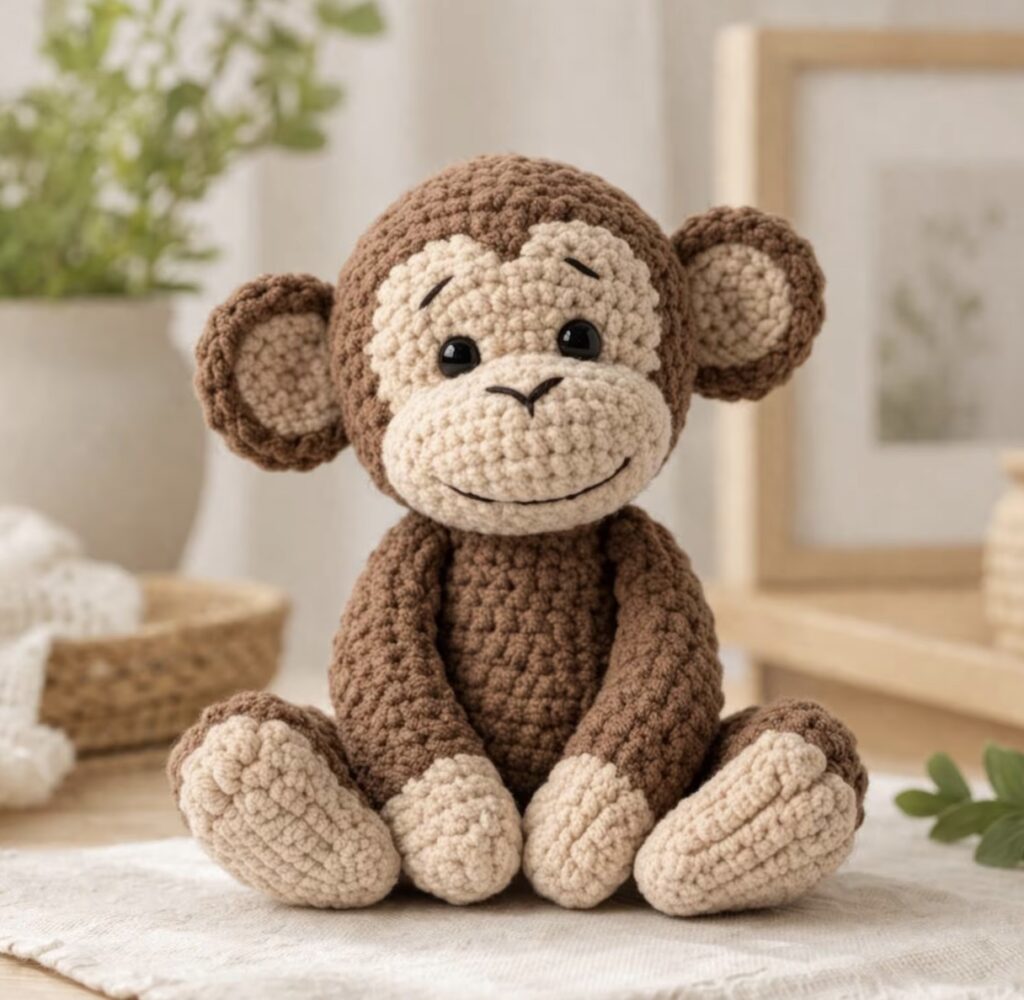

Monkey See, Monkey Do: How Your Hobby Teaches Your Kids
Last Updated: June 30, 2026
Your crochet habit isn’t just good for you — it’s secretly teaching your kids resilience, creativity, and self-belief. Here’s the psychology behind it.
You’re not just crocheting. You’re teaching.
But this method doesn’t include a lecture or a worksheet. You teach by doing — by sitting on the couch with your hook and yarn while your kid plays nearby. You’ve been doing this for your kids their whole lives. In fact, according to psychologist Albert Bandura’s Social Learning Theory (1977), children learn more from watching their caregivers than from almost any direct instruction you could give them.
[Why 10 min Habits stick – and How Crochet Became Mine.]
Modeling creativity for children — the act of letting kids see you make, learn, and struggle with a creative hobby — teaches patience, persistence, and self-belief without you ever having to say a word about it.
Here’s what the research actually says, plus what it looks like in real life when a slightly chaotic mom tries to count stitches with an audience. [1]
What Is Observational Learning, and Why Does It Work for Kids?
Observational learning — the process by which children learn behaviors simply by watching others — is one of the most powerful educational forces in your home. Bandura introduced this concept in his landmark 1977 work Social Learning Theory, and it remains foundational to developmental psychology.
Children don’t wait for a formal lesson. They watch what you do, how you respond to frustration, what you seem to enjoy, and whether your effort gets rewarded. Then, gradually, they start to replicate it.
The people they watch most? Their parents. Because you are an attachment figure — someone whose behavior feels meaningful and relevant to them — your daily habits carry extra weight. Crocheting on the couch every evening isn’t background noise. It’s data your kid is actively collecting.
[1]
The 4 Processes That Turn Watching Into Learning
Bandura proposed four cognitive processes that determine whether a child actually learns from observing a model. They are: attention, retention, reproduction, and motivation. Here’s how they play out when you incorporate creativity into your everyday.
1. Attention: They’re Watching More Than You Think
Children naturally pay close attention to parents because parents are their most important attachment figures [4]. This means your kid isn’t just noticing that you crochet — they’re noticing your yarn colors, the texture of the fabric growing in your lap, and most importantly, your face while you do it.
They see your enjoyment. They also see your frustration and both matter.
When your child watches you work through a dropped stitch without throwing the whole project out the window, they’re getting something more valuable than a crochet lesson. They’re learning that you can struggle with something and keep going anyway.
2. Retention: They Remember Everything (Including the Embarrassing Stuff)
Children store mental representations of what they observe — even when they’re not actively participating. They are building a mental map of how crochet works: what tools are used, how long projects take, what a finished piece looks like.
They also remember your counting face.
My son watched me stare intensely at my project while trying to track a stitch count. Weeks later, he spotted me making the exact same expression over a recipe that served ten and needed to serve three. He announced, loudly: “Mommy, are you counting?”
Yes, I have dyscalculia and apparently a very memorable face when I’m trying to do math. But the point stands: kids file this information away and generalize it. He didn’t just remember crochet-me — he connected effort-face to working through something hard. That’s retention doing its job.
3. Reproduction: Monkey See, Monkey Do
Eventually, after enough observation, children try to replicate what they’ve seen. This doesn’t always look like picking up a hook. It might look like wrapping yarn around a toy, asking to carry their own ball of yarn through the craft store, or incorporating your scrap pile into their artwork.
My son recently walked through our local yarn store identifying the exact shades he wanted for a Pokémon crochet project. He picked a green for Bulbasaur with the confidence of someone who has absolutely spent time thinking about this. The store owner was delighted. I was equal parts proud and slightly concerned about my yarn budget.
He doesn’t crochet yet. But he’s reproducing the identity — I create, and so does he. His medium is colored pencils and glue sticks. The habit of making things? That’s already his.
4. Motivation: Rewards They See Others Receive
Children are more likely to repeat behaviors that appear rewarding. The key word is appear — they don’t need the reward themselves. Bandura called this vicarious reinforcement [1]: a child observes someone else receive positive feedback and internalizes the lesson.
When my mother-in-law saw my finished sweater and said, “Did you make this? It’s gorgeous!” — my son heard that. He watched my reaction. He saw that making something beautiful earns admiration and makes the person who made it visibly happy.
He now tells people I made things. Unprompted and with pride. I won’t lie — it’s gotten me through more than one project I wanted to abandon.
But external praise isn’t the only motivator. Your kid also notices your mood. They see you sit down frazzled and stand up calmer. They see you beam when you finish something. They watch you wrap a handmade gift and see the receiver’s face when they open it. All of that is motivating.
[The Case for Crochet: What the Research Says About Creativity and Mental Health]
What’s the End Goal?

Self-Efficacy — and It’s a Big Deal
Self-efficacy — a person’s belief in their own ability to succeed at a task — is one of the strongest predictors of whether someone will even attempt a difficult thing. Bandura introduced this concept in his 1986 work Social Foundations of Thought and Action, and researchers Schunk and DiBenedetto (2020) confirmed in a modern review that self-efficacy directly impacts motivation, persistence, and learning outcomes [2, 5].
One of the most powerful ways children develop self-efficacy is by watching similar people — like their parents — succeed at hard things. Not just arrive at a finished product. Actually struggle, frog the row, try again, and eventually hold up something they made.
This matters because kids don’t usually get to see adults learning. They see adults cooking with confidence, writing without erasing everything, managing a household that appears (debatably) functional. By the time a skill is visible to kids, it usually looks easy.
Crochet breaks that illusion. When you learn a new stitch in front of your kid, you’re showing them:
- Mistakes are a normal part of learning, not a sign you’re bad at something
- “Can’t” just means “haven’t yet” — progress comes from trying again
- Getting better at something takes practice, not natural talent
- Frustration is survivable
Those lessons don’t stay in the craft room. They travel with your kid into every hard thing they’ll face.
In our house, we’ve retired the word can’t. We say I haven’t figured it out – yet. Honestly, crochet gave me more opportunities to model that phrase than I expected.
How Modeling a Creative Hobby Shapes Your Child’s Identity
Children don’t just copy behaviors. Over time, observed behaviors start forming beliefs: “In our family, we make things.” “My mom is creative, so maybe I am too.” [6]
Research on family creative environments [7] indicates that homes where creativity is visible and actively encouraged are associated with greater creativity and well-being in children.
EXTERNAL LINK: Social Cognitive Theory: An Agentic Perspective
Every time your child picks up a colored pencil while you crochet, they are quietly deciding that creativity is part of who they are.
That identity doesn’t require you to push it, you don’t need to narrate it and you don’t need a curriculum. You just need to keep showing up with your hook, your yarn, and your very expressive counting face.
What This Means for the Mom Who Feels Guilty About Her Hobby

If you have ever talked yourself out of crocheting because you should be doing something more productive — this one’s for you.
Taking time for a creative habit isn’t something you’re doing instead of parenting. According to Bandura’s social cognitive theory (2001), children actively shape their environments through the behaviors they observe and internalize. The environment you’re creating when you crochet in front of your kids is one that says: rest matters, creativity matters, and making time for yourself is something adults do. [3, 7]
That’s more impactful than you think. That’s the kind of home environment associated with better outcomes for kids — not because you sat them down and told them so, but because they watched you live it.
Ready to make room for your own creative time, guilt-free? Download the free 5 Shifts to Daily Creativity Guide.
The Bottom Line
Modeling creativity for children — through a daily habit like crochet — teaches patience, resilience, self-efficacy, and creative identity without a single lesson plan. According to Albert Bandura’s social cognitive theory, children learn through attention, retention, reproduction, and motivation: four processes that activate simply because they’re in the same room as you while you make something. [1, 10]
Your 10 minutes isn’t just for you. It’s for them, too. So throw the guilt out the window. It doesn’t serve you, it doesn’t serve your art, and it certainly doesn’t serve your kids.
Your kids don’t need you to have a perfect creative routine. They need to see you keep coming back to one. And the routine that lasts is the one that fits how your days actually go.
The free Momentum Style Quiz shows whether you build momentum through a steady daily ritual, focused bursts, stolen moments or project milestones. Then it gives you three things you can do this week.
FAQs: Modeling Creativity for Children
Q: Does my child have to watch me crochet for this to work?
A: Not necessarily. The core benefit comes from children observing a parent engaging in any creative practice with genuine investment. Crochet is particularly effective because it’s visible, tactile, and done in short sessions that fit around family life — but drawing, knitting, and other crafts offer similar modeling opportunities.
Q: What age do kids start picking up on modeled behaviors?
A: Observational learning begins in infancy, but it becomes especially influential in children ages 3–8, when social referencing — looking to caregivers to understand how to interpret and respond to the world — is at its peak. Even toddlers will begin imitating behaviors they’ve repeatedly observed. [9]
Q: What if my kids interrupt me the whole time?
A: That’s actually fine — and honestly expected. The interruptions don’t erase the modeling. Children are still registering that you return to your project, that you keep going after a break, and that this is an activity you value enough to come back to. You don’t need an uninterrupted session for the lesson to land.
Q: Does it matter if I’m a beginner and make lots of mistakes?
A: Mistakes are arguably more valuable to model than polished skill. When children see a parent make an error, frog a row, and try again without spiraling — that’s a masterclass in resilience. Watching an expert makes a skill look effortless. Watching a learner makes it look achievable.
Q: What if I crochet after my kids go to bed?
A: That still counts for your mental health! But if you want the modeling benefit, find even one session a week when your kids can see you doing it. It doesn’t need to be every day to leave an impression — consistency over time matters more than frequency in any given week. [8]
Citations
1. Bandura, A. (1977). Social Learning Theory. Englewood Cliffs, NJ: Prentice Hall. (Book – no DOI)
2. Bandura, A. (1986). Social Foundations of Thought and Action: A Social Cognitive Theory. Englewood Cliffs, NJ: Prentice Hall. (Book – no DOI)
3. Bandura, A. (2001). Social cognitive theory: An agentic perspective. Annual Review of Psychology, 52, 1–26.
DOI: https://doi.org/10.1146/annurev.psych.52.1.1
4. Bowlby, J. (1988). A Secure Base: Parent-Child Attachment and Healthy Human Development. Routledge.
(Book – no DOI)
5. Schunk, D. H., & DiBenedetto, M. K. (2020). Motivation and social cognitive theory. Contemporary Educational Psychology.
DOI: https://doi.org/10.1016/j.cedpsych.2019.101832
6. Oyserman, D. (2009). Identity-based motivation: Implications for action-readiness, procedural-readiness, and consumer behavior. Psychological Inquiry, 20(2–3), 250–260.
DOI: https://doi.org/10.1016/J.JCPS.2009.05.008
7. Fan, J., & Zhang, L. F. (2014). The role of perceived parenting styles in thinking styles. Creativity Research Journal, 26(2), 204–211.
DOI: 10.1016/j.lindif.2014.03.004
8. Lally, P., van Jaarsveld, C. H. M., Potts, H. W. W., & Wardle, J. (2010). How are habits formed? Modelling habit formation in the real world. European Journal of Social Psychology, 40(6), 998–1009.
DOI: https://doi.org/10.1002/ejsp.674
9. Berk, L. E. (Latest edition). Development Through the Lifespan. Pearson.
(Book – no DOI)
10. Csikszentmihalyi, M. (1996). Creativity: Flow and the Psychology of Discovery and Invention. HarperCollins. (Book – no DOI)
Pingback: Why 10-Minute Habits Stick – and How Crochet Became Mine - My Daily Stitch