

Can People with ADHD Build Habits? Yes — Here's How
ADHD makes habit formation harder — but not impossible. Learn how to reduce executive function demands so habits actually stick.
Here’s the myth: people with ADHD can’t build habits.
Here’s the truth: the habit advice most people follow was never designed for their brain. Research doesn’t suggest that ADHD makes habit formation impossible — it suggests that ADHD raises the executive function cost of the behaviors that eventually become habits. That’s a very different problem, and it has a very different solution.
Whether you’re navigating a clinical ADHD diagnosis or you’re a mother so deep in the cognitive load of caregiving that your brain is running on fumes by 7pm — the fix isn’t better willpower. It’s a smarter system.
In this post, we’re going to break down exactly what habit formation actually requires, where conventional habit advice breaks down for brains under pressure, and what to do differently.
The Myth That People With ADHD Can’t Build Habits
The idea that ADHD prevents habit formation is misleading — and it’s causing real harm.
Yes, there is robust evidence that ADHD affects executive function, routine management, and consistency. [6] And yes, most habit advice assumes you have intact executive function. Those two facts together have led to a conclusion that feels logical but isn’t supported by the research: that people with ADHD simply cannot build habits.
I get why the conclusion was drawn. The standard habit loop — find a cue, do the routine, reward yourself — sounds simple. It isn’t simple when you’re dealing with forgetfulness, difficulty initiating tasks, reduced working memory, and trouble switching between activities.
But the research doesn’t say you’re incapable. It says the executive function burden is higher. The solution isn’t abandoning habit formation. The solution is reducing the burden required to maintain the behavior long enough for the habit to take root.

What Habit Formation Actually Requires
Habit formation requires four things: a specific cue, a consistent routine, an immediate reward, and — this is the one most habit systems skip — environmental support.
Environmental support is the make-or-break factor when executive function is under pressure. [12, 7] It doesn’t mean having a cheerleader. It means designing your physical surroundings to reduce friction and remove decisions.
Here’s what that looks like in practice. You’ve decided to crochet for 10 minutes after the kids go to bed, before picking up your phone. Environmental support looks like this: a basket on the couch holds your yarn, hook, pattern, stitch markers, and a manual timer. Your phone charger is plugged in across the room. You walk in, plug in your phone, sit down next to your basket, and start.
Now here’s what happens without it. Your yarn is in the bedroom. The pattern isn’t with it. You spend 10 minutes finding both, realize you need better lighting, get up to flip the switch, pass your phone on the way, answer a text from your best friend, and look up 30 minutes later with an untouched project beside you.
Every moment of friction makes completing the routine less likely. Eliminating those friction points is not a hack — it’s the actual mechanism of habit formation for a brain with limited executive bandwidth. [8]
The Executive-Function Trap: What Most Habit Systems Get Wrong
Most habit systems are built on four assumptions that quietly exclude ADHD brains and exhausted mothers — and none of them are stated out loud [6].
Assumption #1: You’ll Remember to Do It
Most habit systems rely on memory — recalling a cue, tracking a streak, keeping the habit on your mental radar. For brains managing ADHD or the relentless cognitive load of motherhood, memory infrastructure is often the first thing to go.
This is why an anchor point — a recurring life event rather than a fixed time on the clock — is more reliable than a reminder. After the kids go to bed holds even when bedtime runs an hour late on vacation. The anchor moves with your life instead of against it.
Assumption #2: The Plan You Made Will Still Work on Wednesday
Planning-dependent habits place a heavy tax on the prefrontal cortex — the part of the brain responsible for executive function. When that resource is depleted, the plan that felt perfectly reasonable on Sunday night becomes genuinely impossible by Wednesday.
The solution is specificity before you need it. A vague habit loop like “I’ll crochet before bed” leaves too many unanswered questions in the moment: Which project? Which hook? Where’s the pattern? Each question requires executive function you may not have.
A solid habit loop closes all of those doors in advance: I am going to crochet for 10 minutes on the couch right after I put the kids to bed. I’ll work on the baby blanket — the pattern is in the basket along with my hook and yarn. My phone will be plugged in across the room before I sit down. When my timer goes off, I get to scroll.
The less detail in your plan, the more executive function you’ll need in the moment. Set it up when you’re rested. Run it when you’re not.
“That’s your executive function system running on a temporary dopamine loan.”
Assumption #3: Starting Is the Easy Part
Most habit frameworks assume task initiation — the ability to simply start — is a given, and that consistency over time is the real challenge. For ADHD brains and overwhelmed mothers, the opposite is often true.
Knowing what to do is rarely the problem. Crossing the gap between intention and action is. [11]
It’s worth separating this from the ADHD hyperfocus experience. If you’ve ever launched into a new hobby with every cylinder firing, only to lose all momentum a week later — that’s not strong task initiation. That’s your executive function system running on a temporary dopamine loan.
Some ADHD researchers and clinicians have described ADHD motivation as being more responsive to interest, novelty, challenge, and urgency than to importance alone. [15] When something is new or emotionally charged, the dopamine response can make starting feel effortless — even compulsive. That’s the hyperfocus window. When novelty fades, the interest-based ignition system loses its fuel. The habit hasn’t gone anywhere. The brain’s ability to start it has.
Most habit frameworks assume initiation gets easier over time as the activity becomes routine. For many ADHD brains, routine removes the very trigger that made starting possible.
The fix isn’t blowing up the habit. It’s introducing enough novelty to re-engage the interest-based system without losing the routine itself. Crochet is particularly well-suited to this — the core habit stays intact while the project, technique, or challenge shifts. Bored with basic stitches? Tunisian crochet is the same skill and a completely different game.
Assumption #4: You’ll Adapt When Life Interrupts
Cognitive flexibility — the ability to generate a new plan when the original one falls through — is treated as a given in most habit systems. Miss a day? Adjust your timing? Swap your context? These are all executive function tasks.
When mental bandwidth is already stretched thin, the result of disruption usually isn’t I’ll adapt. It’s I’ll start again next week. Which becomes next month. Which becomes never.
The solution is building a habit so low-friction that adaptation is rarely required — and so clearly defined that when you do need to adapt, the decision is already made.
What ADHD and Overwhelmed Mothers Have in Common
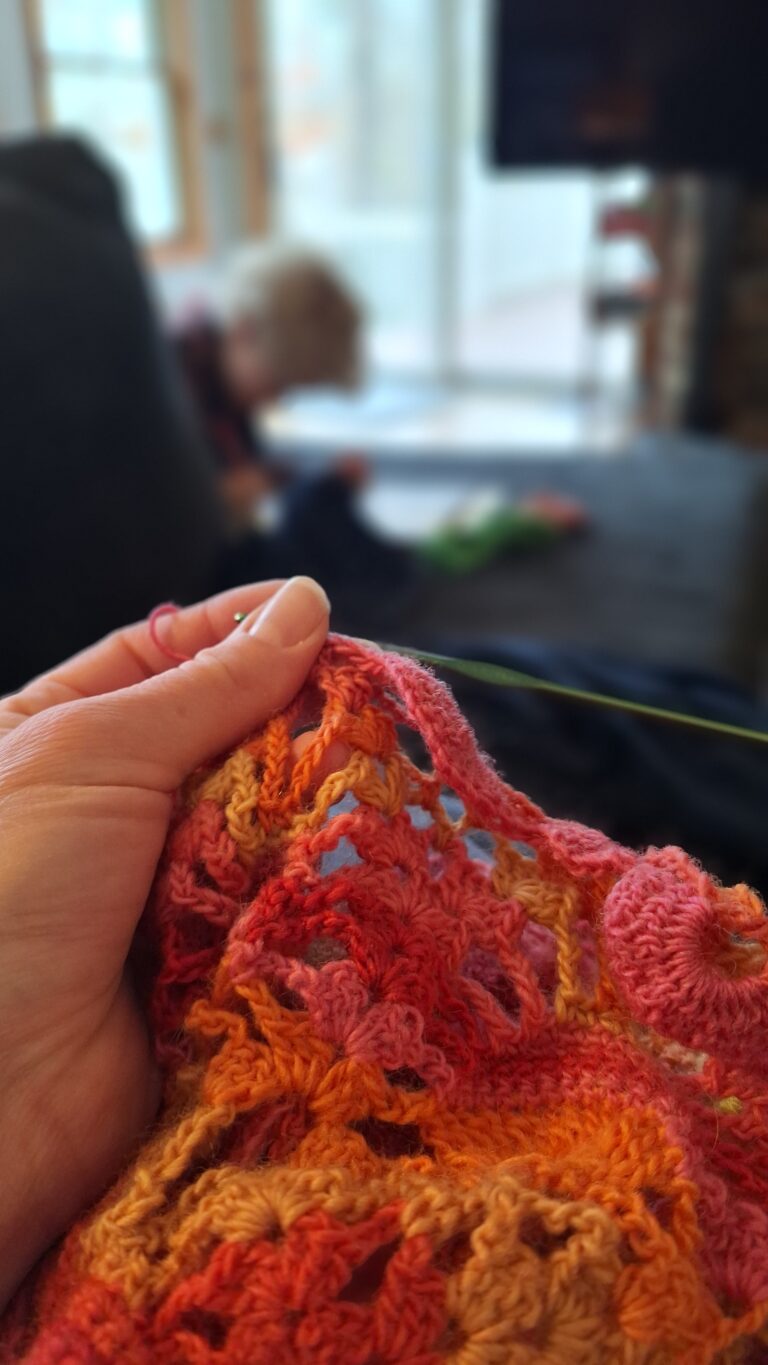
You might be wondering: do I have ADHD, or am I just a depleted mother?
That’s a genuinely complicated question. Only a qualified clinician can tell you, and for some women the answer is both. Women are frequently diagnosed with ADHD later in life than men, and the diagnosis often coincides with a major life change — like becoming a mother. [13, 14] For many, the coping strategies that worked before motherhood stop working under the cognitive load of caregiving. The overlap between the two experiences is significant — and it matters for how you approach habit building.
Here’s where ADHD and maternal overwhelm converge most directly:
Working Memory
Working memory — the mental workspace where we hold and manipulate information in real time — is compromised in both ADHD and severe maternal overwhelm [4, 5].
Here’s what this looks like on a Tuesday night. You’re walking to the living room to crochet. You pass a t-shirt draped over a chair. The t-shirt overrides the information you were holding — crochet routine replaced by laundry. Not from lack of motivation. From a short-term holding system that was already at capacity.
The goal isn’t perfect memory. It’s enough visual cues that distractions can be overcome. That’s what the basket by the couch is for. You may have been momentarily derailed by the t-shirt — but when you sit down, the yarn is right there.
Planning
Planning requires mentally projecting into the future and sequencing actions toward a goal. For ADHD brains, this is structurally harder. For mothers surviving day-to-day, the planning horizon shrinks until long-range thinking feels like a luxury the brain can’t afford.
The anchor point solves this by removing the need to plan at all. After bedtime is going to happen regardless of where you are or what time it falls. You don’t need to arrange the details a month in advance. You just need to know your anchor — and trust that it will hold.

Task Initiation
Task initiation often looks like laziness from the outside. Internally, it’s better described as a misfiring ignition. The desire is there. The intention is there. The start signal doesn’t come.
ADHD disrupts this neurologically. Overwhelm disrupts it through depletion. The functional experience is remarkably similar regardless of cause.
This is where the minimum viable habit becomes essential. Some nights, the minimum viable habit is picking up the hook and yarn. No exaggeration. That’s it. The routine is preserved. The signal to the brain — this is what we do after bedtime — remains intact. Follow through with the reward even on the bare-minimum nights, because working through resistance is its own win.
Here’s the magic part: telling yourself you only have to pick up the hook and yarn is often all the brain needs to start. Once the yarn is in your hands, you’re already there. Might as well crochet.
[Need to overcome the guilt as well? Read: Why 10-Minute Habits Stick – and How Crochet Became Mine]
Decision Fatigue
Decision fatigue — the mental depletion that follows repeated acts of choosing — hits both groups hard and early. Mothers make hundreds of micro-decisions before noon. ADHD brains are already working harder to manage executive function. [6] By the time either person reaches the moment their habit was supposed to happen, the fuel for choosing, initiating, and following through may already be spent.
The solution is making all the decisions in advance, when you’re rested and motivated. Set up your habit loop during a high-energy moment — but keep it realistic. I know the initial enthusiasm wants you to commit to 45 minutes a night. Don’t. Set the bar frustratingly low. That’s the routine that will actually survive when the fatigue sets in.
Emotional Overwhelm
When executive function is gone, feelings are the ones left in charge.
ADHD is closely linked to emotional dysregulation — feelings that arrive fast, loud, and hard to redirect [2, 3]. Overwhelmed motherhood brings its own emotional intensity: guilt, anxiety, identity grief, the particular exhaustion of being perpetually needed. In both cases, a flooded emotional state competes directly with the calm, regulated nervous system that habit formation requires.
This is the hardest one to work around — because it’s the act of doing the creative habit that restores emotional regulation. That’s exactly why the setup matters so much. When the system is working, the habit finds you even on the nights you’re too overwhelmed to go looking for it.
[The Case for Crochet — The research on crochet and emotional regulation]
Identity: The Habit System That Runs on Its Own
Making the habit part of your identity feels a little like magic. The behavior stops being something you’re trying to do and starts becoming something people like you simply do.
Identity reduces the number of decisions required to perform a behavior. [10] Every time you have to decide whether to crochet, you’re spending mental energy you may not have. When you see yourself as a crocheter, the decision is already made.
This is a form of cognitive offloading — the same psychological mechanism as putting your hook and yarn in a basket by the couch. Instead of repeatedly asking should I crochet?, the identity has already answered that question. The habit isn’t something you’re trying to do. It’s something you are. [9, 10]
The shift in self-talk is subtle but significant. “I should crochet more” requires a decision every single time. “I am a crocheter” doesn’t. When you miss three days, the thought isn’t I failed — it’s I haven’t crocheted lately. The identity remains intact. The behavior briefly lapsed. Those are very different things, and the difference is what makes returning easy.
Add a community identity and the structure becomes even more resilient. A habit tracker can remind you to crochet. A project basket can make it easier to start. A community reinforces that this is who you are.
When Betty from your crochet community asks “how’s the sweater coming?” they’re not asking whether you’re a crocheter. They already assume you are. In a quiet but powerful way, they’re holding that identity for you until you’re ready to hold it again.
[Haven’t met Betty yet? Read: Why Community Matters]
How to Build a Habit Loop That Actually Works With Your Brain
Here’s the full picture, reduced to its essentials:
Instead of relying on memory → use an anchor point and physical visual cues.
Instead of needing discipline → remove friction so success is the path of least resistance.
Instead of starting over after a missed day → simply return tomorrow. The identity holds.
Instead of staying motivated → build accountability into your environment and your community.
Instead of pushing harder → make the habit so small and accessible it becomes nearly impossible not to complete.
People with ADHD can absolutely build habits. So can mothers running on empty. What they need isn’t a better version of the same advice. They need a system designed for the brain they actually have — not the brain the habit gurus assumed they had.
The Bottom Line
ADHD habit formation isn’t about trying harder with the same broken system. It’s about building a different system — one with an anchor point instead of a clock, visual cues instead of memory, and a definition of success small enough to survive your hardest days.
The techniques that work best for ADHD brains — reduced decision-making, environmental design, minimum viable habits — are the same techniques that help everyone get through the difficult early phase of habit formation. You’re not the exception to the rule. You’re the clearest example of what the rule was always pointing toward.
If you’re ready to build a crochet habit designed for real life, start by finding out how you build momentum. The free Momentum Style Quiz shows whether you’re a Sprinter, Ritualist, Project Planner or Opportunist, then gives you three things you can act on today.
➝ Take the free Momentum Style Quiz
Last updated: September 29, 2026
FAQs: ADHD Habit Formation
Q: Can people with ADHD really build habits?
A: Yes. Research does not suggest ADHD makes habit formation impossible — it suggests that ADHD raises the executive function cost of building habits. The solution is reducing that cost through environmental design, anchor points, and a minimum viable habit, not abandoning habit formation altogether.
Q: How long does it take to build a habit with ADHD?
A: In one well-known study, it took participants an average of 66 days, just over 2 months, for a new behavior to become automatic, with individual times ranging from 18 – 254 days (Lally et al., 2010)[1]. For people with ADHD, the timeline may be longer. More environmental support and less friction can help close the gap.
Q: What is an anchor point habit and why does it work for ADHD?
A: An anchor point habit — for example, “after the kids go to bed” — ties a new behavior to a recurring life event rather than a fixed time. This works for ADHD because it removes the need to plan or remember a specific time, and it holds even when routines shift due to travel, illness, or schedule changes.
Q: What is a minimum viable habit?
A: A minimum viable habit is the smallest possible version of a behavior that still counts as completing the routine. For crochet, it might be picking up the hook and yarn — nothing more. This preserves the habit signal in the brain on low-capacity days and prevents the all-or-nothing collapse that derails most habit attempts.
Q: Why do I hyperfocus on a new hobby and then lose all motivation?
A: This pattern is common with ADHD. Some clinicians describe ADHD motivation as driven more by interest, novelty and urgency than by importance. When the novelty fades, so does the easy “on” switch. The fix isn’t abandoning the habit. It’s building in enough variety to keep things interesting without losing the underlying behavior.
Citations
- Lally, P., van Jaarsveld, C. H. M., Potts, H. W. W., & Wardle, J. (2010). “How are habits formed: Modelling habit formation in the real world.” European Journal of Social Psychology, 40(6), 998–1009.DOI: https://doi.org/10.1002/ejsp.674
- Barkley, R. A., & Fischer, M. (2010). “The unique contribution of emotional impulsiveness to impairment in major life activities in hyperactive children as adults.” Journal of the American Academy of Child & Adolescent Psychiatry, 49(5), 503–513. DOI: https://doi.org/10.1016/j/jaac.2010.01.01910.1097/00004583-201005000-00011
- Shaw, P., Stringaris, A., Nigg, J., & Leibenluft, E. (2014). “Emotion dysregulation in attention deficit hyperactivity disorder.” American Journal of Psychiatry, 171(3), 276–293. DOI: https://doi.org/10.1176/appi.ajp.2013.13070966
- Martinussen, R., Hayden, J., Hogg-Johnson, S., & Tannock, R. (2005). “A meta-analysis of working memory impairments in children with attention-deficit/hyperactivity disorder.” Journal of the American Academy of Child & Adolescent Psychiatry, 44(4), 377–384. DOI: https://doi.org/10.1097/01.chi.0000153228.72591.73
- Alderson, R. M., Kasper, L. J., Hudec, K. L., & Patros, C. H. G. (2013). “Attention-deficit/hyperactivity disorder (ADHD) and working memory in adults.” Neuropsychology, 27(3), 287–302. DOI: https://doi.org/10.1037/a0032371
- Willcutt, E. G., Doyle, A. E., Nigg, J. T., Faraone, S. V., & Pennington, B. F. (2005). “Validity of the executive function theory of ADHD: A meta-analytic review.” Biological Psychiatry, 57(11), 1336–1346. DOI: https://doi.org/10.1016/j.biopsych.2005.02.006
- Gardner, B. (2015). “A review and analysis of the use of ‘habit’ in understanding, predicting and influencing health-related behaviour.” Health Psychology Review, 9(3), 277–295. DOI:
https://doi.org/10.1080/17437199.2013.876238 - Fogg, B. J. (2009). “A behavior model for persuasive design.” Proceedings of Persuasive ’09. DOI: https://doi.org/10.1145/1541948.1541999
- Verplanken, B., & Orbell, S. (2003). “Reflections on past behavior: A self-report index of habit strength.” Journal of Applied Social Psychology, 33(6), 1313–1330. DOI: https://doi.org/10.1111/j.1559-1816.2003.tb01951.x
- Oyserman, D. (2009). “Identity-based motivation: Implications for action-readiness, procedural-readiness, and consumer behavior.” Journal of Consumer Psychology, 19(3), 250–260. DOI: https://doi.org/10.1016/j.jcps.2009.05.008
- Rhodes, R. E., & Dickau, L. (2012). “Experimental evidence for the intention-behavior relationship in the physical activity domain: A meta-analysis.” Health Psychology, 31(6), 724-727. DOI: 10.1037/a0027290
- Wood, W., & Neal, D. T. (2007). “A new look at habits and the habit-goal interface.” Psychological Review, 114(4), 843–863. DOI: https://doi.org/10.1037/0033-295X.114.4.843
- Quinn, P. O., & Madhoo, M. (2014). “A review of attention-deficit/hyperactivity disorder in women and girls: Uncovering this hidden diagnosis.” The Primary Care Companion for CNS Disorders, 16(3). DOI:
https://doi.org/10.4088/PCC.13r01596 - Ninowski, J. E., Mash, E. J., & Benzies, K. M. (2007). “Symptoms of attention-deficit/hyperactivity disorder in first-time expectant women.” Infant Mental Health Journal, 28(1), 54-75. DOI: 10.1002/imhj.20122
- Volkow, N. D., Wang, G.-J., Newcorn, J.H., Kollins, S.H., Wigal, T.L., Telang, F., Fowler, J.S., Goldstein, R.Z., Klein, N., Logan, J., Wong, C., Swanson, J.M. (2011). “Motivation deficit in ADHD is associated with dysfunction of the dopamine reward pathway.” Molecular Psychiatry, 16(11), 1147-1154. DOI: https://doi.org/10.1038/mp.2010.97